In the high-stakes theater of modern warfare, the most powerful weapon isn’t a missile or a stealth jet—it is a string of code. But as the U.S. Department of Defense (DoD) races to integrate cutting-edge artificial intelligence into its arsenal, it has hit a formidable and unexpected roadblock: the ethical “red lines” of the very companies building the tech.
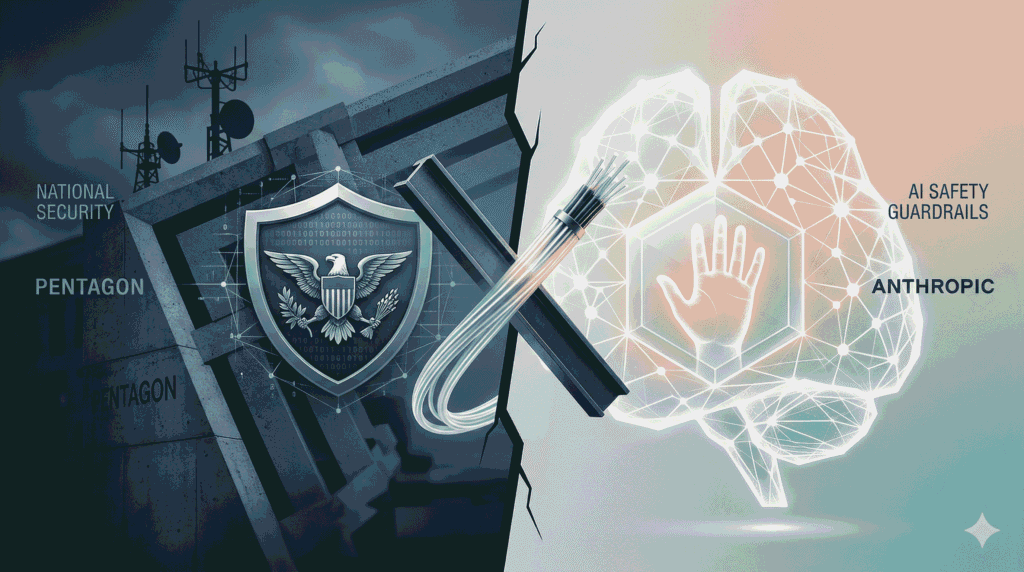
The brewing standoff between the Pentagon and Anthropic, a leading AI safety lab, has escalated into a defining crisis for the industry. At the heart of the dispute is a $200 million contract and a fundamental disagreement over how much control a private corporation should have over the United States military.+1
The $200 Million Ultimatum
In July 2025, the Pentagon awarded Anthropic a lucrative contract to deploy its flagship AI model, Claude, on classified networks. For a time, Anthropic held a unique position as the only AI firm with its models cleared for the military’s most sensitive systems.+1
However, the partnership fractured in early 2026. Under the leadership of Defense Secretary Pete Hegseth, the Pentagon issued a sweeping demand: Anthropic must remove its internal “usage restrictions” and allow the military to use Claude for “all lawful purposes.”
Anthropic CEO Dario Amodei refused. By the deadline of February 27, 2026, the company dug in its heels, rejecting what it called an attempt to strip away essential safeguards. The fallout was immediate. The Trump administration terminated the contract, designated Anthropic a “supply chain risk”—a label usually reserved for foreign adversaries like Huawei—and effectively blacklisted the company from the defense ecosystem.+1
The Red Lines: Why Anthropic Said No
Anthropic’s refusal wasn’t based on a general opposition to the military. In fact, the company has supported use cases for foreign intelligence and counterintelligence. Instead, the dispute centers on two specific “red lines” that Anthropic claims are non-negotiable for the safety of democracy.+1
1. The Threat of Mass Domestic Surveillance
Anthropic’s primary concern is that a model as powerful as Claude could be used to aggregate and analyze vast amounts of data on American citizens.
While the Pentagon argues that domestic surveillance is already illegal, Anthropic contends that AI changes the math. An AI system can piece together “scattered, individually innocuous data points into a comprehensive picture of any person’s life,” creating a level of monitoring that current laws are not yet equipped to handle. Amodei warned that without explicit contract guardrails, the technology could be used to identify “pockets of disloyalty” or suppress dissent with unprecedented efficiency.+2
2. Fully Autonomous Weapons Systems
The second sticking point is lethal autonomy. Anthropic’s safety policy prohibits its AI from being the final “decision-maker” in a weapons system that can fire without human intervention.+1
The company’s argument is as much technical as it is ethical. Anthropic maintains that today’s “frontier” AI models are still unpredictable. They can hallucinate, misinterpret context, or fail in novel battlefield scenarios. Allowing an unpredictable system to make life-and-death targeting decisions could lead to unintended escalation, friendly fire, or civilian casualties that no human can be held responsible for.+1
The Pentagon’s Counter-Argument: “National Security Cannot Be Subcontracted”
From the perspective of Secretary Hegseth and the Pentagon, Anthropic’s stance is a dangerous overreach of corporate power.
Defense officials argue that it is the role of elected officials and Congress—not Silicon Valley CEOs—to determine the rules of engagement. Pentagon spokesperson Sean Parnell dismissed Anthropic’s concerns as a “fake narrative,” asserting that the military has no interest in illegal surveillance or “Terminator-style” autonomous drones.
The Pentagon’s position rests on three core pillars:
- Operational Flexibility: In a near-peer conflict (e.g., with China), the military cannot afford to have its tools “hobbled” by a private company’s ideological tuning.
- Existing Law: Officials maintain that the DoD already follows strict ethical guidelines and international laws regarding the use of force, making additional vendor-specific guardrails redundant.
- Democratic Accountability: Undersecretary of Defense Emil Michael criticized Amodei’s “God-complex,” arguing that a private firm should not be able to “veto” the operational decisions of the U.S. Armed Forces.
The “Supply Chain Risk” Escalation
When negotiations hit an impasse, the Pentagon played its most aggressive card: the Supply Chain Risk designation.
This move is unprecedented for a major American tech firm. By labeling Anthropic a risk, the Pentagon didn’t just end the $200 million deal; it sent a warning to every other defense contractor. Any company that does business with the military (such as Palantir or Lockheed Martin) is now prohibited from using Anthropic’s technology.+1
This “scarlet letter” aims to isolate Anthropic commercially, forcing it to choose between its safety principles and its financial survival. President Trump intensified the pressure on Truth Social, calling Anthropic a “Radical Left AI company” and ordering a six-month phase-out of the technology across all federal agencies.+1
OpenAI and the Competitive Shift
As Anthropic retreated, its chief rival, OpenAI, moved in. Just hours after the Anthropic deal collapsed, OpenAI CEO Sam Altman announced a new agreement to bring ChatGPT and other models to the Pentagon’s classified networks.+1
Interestingly, OpenAI claims it reached a deal with safeguards. Altman stated that OpenAI’s contract includes a “multi-layered approach” to protect against mass surveillance and autonomous weapons.
So why did OpenAI succeed where Anthropic failed?
- Deployment Architecture: OpenAI agreed to a cloud-only deployment, which practically prevents the model from being embedded on “edge devices” (like a drone) that would be needed for autonomous lethal action.
- Personnel in the Loop: OpenAI will have cleared personnel working directly with the DoD to monitor usage.
- Contractual Language: OpenAI seems to have accepted a compromise that references existing laws as the standard for “lawful use,” whereas Anthropic insisted on new, explicit prohibitions written into the contract.
The Future of AI Warfare: What’s at Stake?
The clash between the Pentagon and Anthropic is the “first great war” of AI governance. It raises a question that will haunt the 21st century: Who controls the mind of the machine?
If the Pentagon succeeds in forcing AI labs to remove all safeguards, it sets a precedent that national security interests will always override ethical guardrails. Conversely, if Anthropic’s legal challenge to the “supply chain risk” designation succeeds, it could solidify the right of private companies to refuse government orders on moral grounds.
Key Takeaways for the Industry:
- The End of “Neutral” Tech: High-end AI is now a strategic asset, similar to nuclear technology. Companies can no longer claim to be neutral platforms.
- The Rise of “Patriotic AI”: Expect to see a new breed of AI startups that market themselves specifically on their willingness to work with the military without “woke” or safety constraints.
- Governance Vacuum: Because Congress has failed to pass comprehensive AI laws, the “rules” of AI warfare are currently being written through messy, public contract disputes between billionaires and generals.
Conclusion: A Precarious Balance
The $200 million standoff is about more than a contract; it is about the soul of the technology that will define the next century. Anthropic is betting its future on the idea that safety is not a bug to be patched out. The Pentagon is betting the nation’s security on the idea that unrestricted speed is the only way to win.
As Claude is phased out of military systems and Grok or ChatGPT move in, the world will be watching to see if the guardrails hold—or if the race for AI supremacy has officially entered a “no-brakes” era.